

Repositioning Knowledge Engineering in the LLM Era: Symbolic Scaffolding, Neural Flexibility, and Enterprise Guardrails#
In the enterprise AI stack, RAG, vector retrieval, and agent tool calling are already table stakes; meanwhile, OWL 2 ontology retrieval, biomedical ontologies, and the “model first, then reason” knowledge-graph path continue to run in production. The two technical lineages have long run in parallel, but the spread of LLMs forces them to answer the same set of questions: Can concepts in natural language be stably structured by machines? When edge cases appear, how should category definitions be revised? When enterprise agents write to databases, send messages, or call APIs, at which layer should symbolic guardrails sit?
Bradley P. Allen’s research trajectory (doctoral thesis Neurosymbolic Knowledge Engineering with Natural Language) compresses this tension into an engineering proposition: use neural networks for open-domain input and symbolic scaffolding to preserve auditable reasoning and governance. The sections below unpack each layer by mechanism; claims not verified line-by-line against W3C specifications, papers, or product documentation are labeled speaker’s view or open question.
The formal skeleton of knowledge graphs: terminological layer, assertional layer, and subsumption#
Why: To automatically propagate “properties on classes” to “instances,” you need a computable class hierarchy and consistency checking—not merely a HAS_TYPE edge in a graph database. Industry often equates knowledge graphs with an object–class–relation triple view; Allen emphasizes a lightweight logical overlay above that, in the tradition of Description Logic—speaker’s view.
Mechanism/constraints: The OWL 2 Primer distinguishes terminological knowledge (terminology/class definitions) from assertional knowledge (instance assertions), corresponding to what the DL community calls the T-box and A-box. OWL 2 Direct Semantics defines Class Expression Subsumption: class expression (CE_1) is entailed by (CE_2) if and only if, in all interpretations, ((CE_1)^C \subseteq (CE_2)^C). OWL 2 Profiles Table 10 gives worst-case complexity—consistency and subclass checking in OWL 1 DL are NEXPTIME-complete. Reasoners therefore focus on modest inference (property inheritance, subclass propagation) rather than heavy theorem proving; Allen affirms two decades of engineering value in biomedicine and related fields, while noting that enterprise ROI remains a heavy lift (speaker’s view).
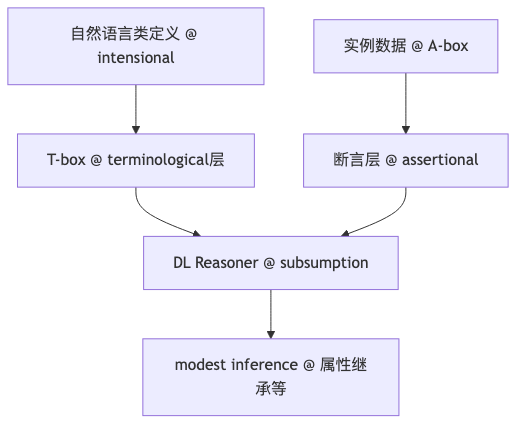
How to: Start from SubClassOf(:Mother :Woman) and use a reasoner to verify whether Mother is a subclass of Person; in enterprise settings, prefer an OWL 2 EL / QL / RL profile to control reasoning cost before deciding whether to introduce richer constructs.
Common pitfalls: Treating a graph database’s “type edge” as equivalent to an OWL subclass relation—the former typically offers no global consistency guarantee; Frank van Harmelen is cited by Allen as observing that readers often “read into” graph symbols from natural-language intuition, causing symbolic meaning to diverge from formal meaning (cited academic view; the interview gives no specific DOI, cannot be independently verified).

The cost of description logic: expressiveness versus tractability#
Why: If arbitrary first-order logic is allowed, reasoning may become undecidable or explode exponentially; knowledge engineering must trade off “can express the business” against “can finish computing.”
Mechanism/constraints: W3C Profiles documentation states that each profile trades some expressive power for the efficiency of reasoning. Allen summarizes the 1990s DL community compromise as lossy formalization: fine distinctions in natural-language concepts are often discarded during formalization in exchange for soundness, completeness (within the chosen logical fragment), and tractability—avoiding reasoning that “returns only at heat death” (speaker’s view; the causal chain is interview synthesis, not W3C original text).
How to: When selecting a stack, first ask which reasoning problems you need—ontology consistency, class expression subsumption, instance checking—then map them to the Profiles complexity table; for hierarchy-only classification, full OWL DL is unnecessary.
Common pitfalls: Assuming “we have a knowledge graph, therefore we have semantics”—if van Harmelen-style “reading in” occurs, formally sound inference may still diverge from business semantics. Another pitfall is expecting KGs to natively handle non-monotonic / defeasible reasoning; Allen notes this has long been a showstopper for the symbolic route, while biomedicine and other fields still achieve results with defeasible reasoning largely unresolved (speaker’s view).
LLMs as classifiers: from intensional definitions to edge-case feedback loops#
Why: Classic knowledge engineering requires experts to hand-translate natural-language intensional (with s) definitions into DL axioms; Allen argues that before LLMs, this path was hard to scale in practice (speaker’s view; could not fetch the full ALLNKE.pdf text to verify experimental details sentence by sentence—the philpapers link returns a challenge page).
Mechanism/constraints: The core move in Allen’s framework is to use natural-language class specifications to directly produce an LLM-based classifier that outputs labels with rationale, for human or automated feedback to revise class definitions; the generative path is costly and can be distilled into lighter models such as logistic regression for scale (subtitles ~12:32–12:52 corroborate wording—interview view). The decision mechanism is probabilistic, more isomorphic to human defeasible reasoning than to classical monotonic deduction.
How to (minimal sketch):
1. Write a class definition in NL: "A reranker = a component that reorders a candidate document set by relevance"
2. LLM classifier labels a new object (e.g., a multi-vector model) + outputs rationale
3. If rationale exposes a definition gap → revise class definition → re-evaluate held-out edge cases
Common pitfalls: Treating a one-shot prompt output as a stable ontology—without a rationale loop, you cannot audit “why it was classified this way.” Another pitfall is ignoring distillation: running frontier LLMs online for every classification is usually unacceptable in cost and latency.
Vector retrieval, ColBERT, and dynamic class boundaries#
Why: Unstructured corpora far exceed what any one-shot manual modeling pass can cover; retrieval-augmented generation (RAG) combines parametric memory with external vector indexes and has become the de facto meeting point of the LM and KG communities.
Mechanism/constraints: ColBERT applies late interaction with token-level multi-vector encoding for queries/documents, aggregating similarity via MaxSim. Khattab & Zaharia (2020) describe two deployments: BM25 retrieval top-1000 → ColBERT re-rank, or ColBERT end-to-end full retrieval (via vector index). In the interview Connor colloquializes this as “ColBERT like a first-stage retriever then re-rank” (subtitle ~25:11); this partially aligns with the paper’s default benchmark (BM25 first stage), but it is not a fixed pipeline of “ColBERT stage one + another reranker”—architecture documents should follow the paper’s two modes. What Allen endorses is the more general edge case → rationale → revise class loop, not specific ColBERT MRR figures (speaker’s view).

How to: Production setups often use hybrid search (vector + BM25) as stage one and ColBERT-class models as stage-two reranking; for class-definition maintenance, treat “does this new retrieval architecture still count as a reranker?” as a regression test case rather than a static enumeration.
Common pitfalls: Using ColBERT as both stage one and stage two without a clear indexing strategy—full retrieval needs a dedicated multi-vector index, with different ops cost from “BM25 candidates then rerank.” Another pitfall is treating retrieval metrics as a substitute for ontology consistency checking—ranking MRR and OWL consistency answer different questions.

Distributional semantics: centroids, topic modeling, and the LLM detour#
Why: When symbolic classes are unavailable or too costly to maintain, engineers turn to distributional semantics—approximating concepts with co-occurrence statistics or vector spaces.
Mechanism/constraints: Word2vec maps words to continuous vectors; LDA models documents as finite mixtures of topics. Allen proposes a heuristic: a concept can be viewed as the centroid of its extension instances in vector space; explicit category vectors (binary can-it-fly, numeric wheels, categorical maker, etc.) can be constructed and compared against object embeddings (speaker’s view; not standard LDA/Word2vec terminology). Pure clustering or topic modeling long struggled with “does this cluster have a nameable semantics?"—LDA summaries emphasize brief topic descriptions but do not solve automatic semantic labeling.
How to: If interpretable categories are needed, maintain explicit feature vectors and use them jointly with embeddings; if open-domain coverage is needed, use LLMs to generate cluster labels or definitions, but retain human spot-check validation.
Common pitfalls: Treating topic IDs as business concept IDs—insufficient cluster interpretability leads downstream agents to misuse them. Allen’s conditional judgment: LLMs combine distributional representation with a language-generation interface and seem to detour around the hard problem of naming clusters, but whether they achieve both interpretability and coverage remains an open question (speaker’s view).

Logic–semantics tradition versus pragmatics: where LLMs sit philosophically#
Why: Engineers often oscillate between “is the model output true?” and “is the model output useful?"—corresponding to the philosophical split between the logic–semantics tradition (truth, compositional meaning) and the pragmatics tradition (meaning in use).
Mechanism/constraints: The Frege line through Russell, Wittgenstein, Turing, and Gödel underpins “technical success stories” such as automated theorem proving—still irreplaceable for closed-domain reasoning that requires soundness. Pragmatics studies context, use, and communication beyond conventional meaning. Allen’s interpretive frame: LLMs generate fluent language but detach from classical truth; if properly guided, they could become the “first viable computational implementation” of the pragmatics tradition (interview view; SEP would not endorse that strong conclusion). Formalization should serve strict reasoning that ultimately requires human “hand-cranking,” not replace end-to-end dialogue (speaker’s view).
How to: Layer the pipeline—use LLMs for open-domain dialogue; for compliance, permissions, financial accounting, and similar steps, translate LLM output into closed fragments (types, units, permission predicates) suitable for theorem provers or rule engines.
Common pitfalls: Replacing structured consensus dialogue with multi-turn chatbot small talk—Allen argues current interaction lacks structure for clarifying concepts and reaching norms, and dialogue output rarely settles into reusable symbolic structure (speaker’s view).

Relevant logics: paraconsistency, paracompleteness, and LLM output#
Why: LLMs often output probabilistic, retractable, mutually incomplete statements; in classical logic, contradiction (A \land \neg A) entails arbitrary (B) (ECQ, ex contradictione quodlibet), which does not match production needs.
Mechanism/constraints: Paraconsistent logic studies non-explosive consequence relations so contradictions do not poison all inference. Relevant logic is an important branch. Allen also mentions paracompleteness (tolerating representational incompleteness) in the interview—a term from annotated logic literature that he juxtaposes with LLM-style “70% likely” statements, envisioning embedding in symbolic reasoning pipelines (speaker’s view; no mainstream product documentation found for LLM + paracompleteness implementations).
How to (conceptual layer): Annotate LLM output with confidence and provenance; on contradiction detection, do not immediately classical-explode—instead isolate conflicting propositions and trigger human or higher-order rule arbitration—engineering practice here is closer to defeasible reasoning and truth maintenance than deploying paraconsistent calculi directly.
Common pitfalls: Assuming “tolerating contradiction” means “abandoning consistency”—enterprise scenarios still require monotonic, auditable write operations and permission decisions. Another pitfall is treating cognitive claims (“the human brain often reasons despite contradictions”) as directly deployable logical theorems.


Neural search and enterprise agents: the AlphaGo analogy’s signifier and limits#
Why: The tool-calling loop of enterprise knowledge agents can be coarsely viewed as state transitions; the host analogizes MuZero-style “tree search + learned world model” to enterprise action spaces such as writing to databases and sending messages (host’s framing question).
Mechanism/constraints: AlphaGo combines value networks, policy networks, and Monte Carlo tree search; AlphaZero unifies multiple board games via tabula rasa self-play; MuZero achieves superhuman performance with tree-based search + learned model even without environment dynamics priors. Allen agrees with the analogy that “search applies not only to physical actions but also to reasoning space,” but admits difficulty “fully grasping” recent RL application spectra; how enterprise AI architecture lands remains an excellent question—the current mainstream is try and see what happens (speaker’s view). The three papers do not discuss Notion writes, RBAC, or similar workflows.
How to: If borrowing search, prioritize simulable, replayable subtasks (query planning, schema navigation) for MCTS or beam search trials rather than betting the full stack on a world model upfront; Weaviate Query Agent-style “stateless, natural-language query writing with schema navigation” contrasts with “memoryful, planning agents” in form (host product description; Query Agent official details not verified).
Common pitfalls: Equating MuZero paper results directly with enterprise agent ROI—board-game state spaces are closed with sparse, clear rewards, unlike enterprise workflows. Another pitfall is ignoring misalignment: when agent goals diverge from enterprise goals, search only reaches the wrong endpoint more efficiently (speaker’s view).
Enterprise neurosymbolic architecture: neural flexibility, symbolic guardrails, and accountability#
Why: Neural networks excel at generalizing to unseen input, but enterprises need norms, audit trails, and permission boundaries—pure end-to-end models struggle to carry that alone.
Mechanism/constraints: Allen’s advocated neurosymbolic division of labor: neural networks handle open-domain perception and language interfaces; symbolic scaffolding carries guardrails, governance, and RBAC (NIST calls RBAC one of the predominant models of advanced access control). van Harmelen et al. A Boxology of Design Patterns for Hybrid Learning and Reasoning Systems supplies vocabulary for hybrid architectures but does not map line-by-line to Weaviate object-level write permissions (Connor mentions casually—not an official documentation claim). Allen calls the present a Cambrian explosion of trial and error; architecture questions “really need to be resolved” (speaker’s view).
How to: Separate at least three layers—(1) identity and role layer RBAC; (2) tool-call allowlists and parameter schema validation; (3) human approval or rollback for high-risk writes. The neural part proposes; the symbolic part allow/denys.
Common pitfalls: Treating “add a system prompt forbidding overreach” as RBAC—prompts have no enforcement at the execution layer. Another pitfall is assuming stronger foundation models will naturally solve governance; Allen’s most exciting direction is instead “how to use the powerful technology that has appeared accountably” (speaker’s view; the nuclear-physics analogy is rhetorical, not a technical equivalence).
Tension between two individualist routes: structure-first versus structure-on-demand#
Allen’s personal knowledge management is “a big pile of files + search,” not a self-built graph (speaker’s view)—in contrast to the high formalization of his doctoral thesis. Connor paraphrases the Groth / Bob van Luijt route: do not pre-structure; let LLMs organize on the fly with context (host paraphrase). On the enterprise side, the Berners-Lee vision of a fully structured web-wide knowledge base has not materialized, while domain ontologies (e.g., biomedicine) still succeed; whether LLMs can dynamically structure while preserving semantics—Allen explicitly marks as an open question. Vector search backed by vector stores and continuous index updates makes knowledge systems more iterative, ongoing processes than “model once, maintain lightly” (speaker’s view); LLM training cutoffs amplify pressure for continuous revision.
On AI cycle judgment, Allen argues history often winters from overestimating capability; after deep learning / LLMs there may be underestimation (Go was estimated 20–25 years out before AlphaGo); short-term AI winter probability is low, but whether this is a bubble remains an open question (speaker’s view; the interview does not develop reproducible evidence for the opposing view of diminishing scaling returns).
If you are implementing this#
- Start with a reasoning-problem checklist: Do you need subsumption / consistency, or semantic retrieval / generation? Then decide whether OWL profiles and vector indexes coexist in one store—avoid disguising one technology’s metrics as another requirement.
- Treat class definitions as versioned specifications: Write clear intensional definitions in NL; use LLM classifiers + rationale to regression-test edge cases; when retrieval components (e.g., ColBERT deployment mode) change, trigger class-definition review.
- Document two-stage roles in the RAG pipeline: Distinguish BM25→re-rank versus full retrieval per the ColBERT paper; do not conflate colloquial “stage-one retrieval.”
- Put symbolic guardrails before agent launch: RBAC, tool schema validation, write auditing, and rollback are more urgent than adding a world model; pilot search/planning on replayable subtasks.
- Mark open-domain versus closed-domain boundaries: LLMs handle the pragmatic interface; steps involving permissions and accounting must produce output translatable into closed logical fragments or explicit defeasible rule sets, with human hand-cranking retained.
References and further reading#
- OWL 2 Primer: terminological versus assertional knowledge
- OWL 2 Direct Semantics: class expression entailment definition
- OWL 2 Profiles: expressiveness and reasoning complexity table
- Allen’s doctoral thesis: neurosymbolic knowledge engineering (PDF)
- Original RAG paper: retrieval-augmented generation architecture
- ColBERT paper: late-interaction multi-vector retrieval
- Weaviate documentation: hybrid search concept
- Word2vec paper: distributed word vector representations
- LDA paper: topic modeling and document mixtures
- SEP: Frege and the origins of formal logic
- SEP: pragmatics and theories of meaning
- SEP: paraconsistent logic and ECQ
- AlphaGo paper: neural networks combined with tree search
- MuZero paper: model learning and search without dynamics priors
- NIST: RBAC access control model overview